What to do about it
Engineer trust around the model
The investigation began as a search for a capable local model and ended as a requirement: assume every model can fail, and build the system so that failure does not become authoritative.
Four principles
- The model can propose; policy and evidence constrain it.
- Verification happens outside the model.
- Authorization is separate from generation.
- Logging does not depend on the model.
Retrieval is not provenance, citations are not proof, local control is not complete control, and TOPS are not trust.
Eight recommendations
- Stop selling compute as trust. Publish trust characteristics alongside performance characteristics.
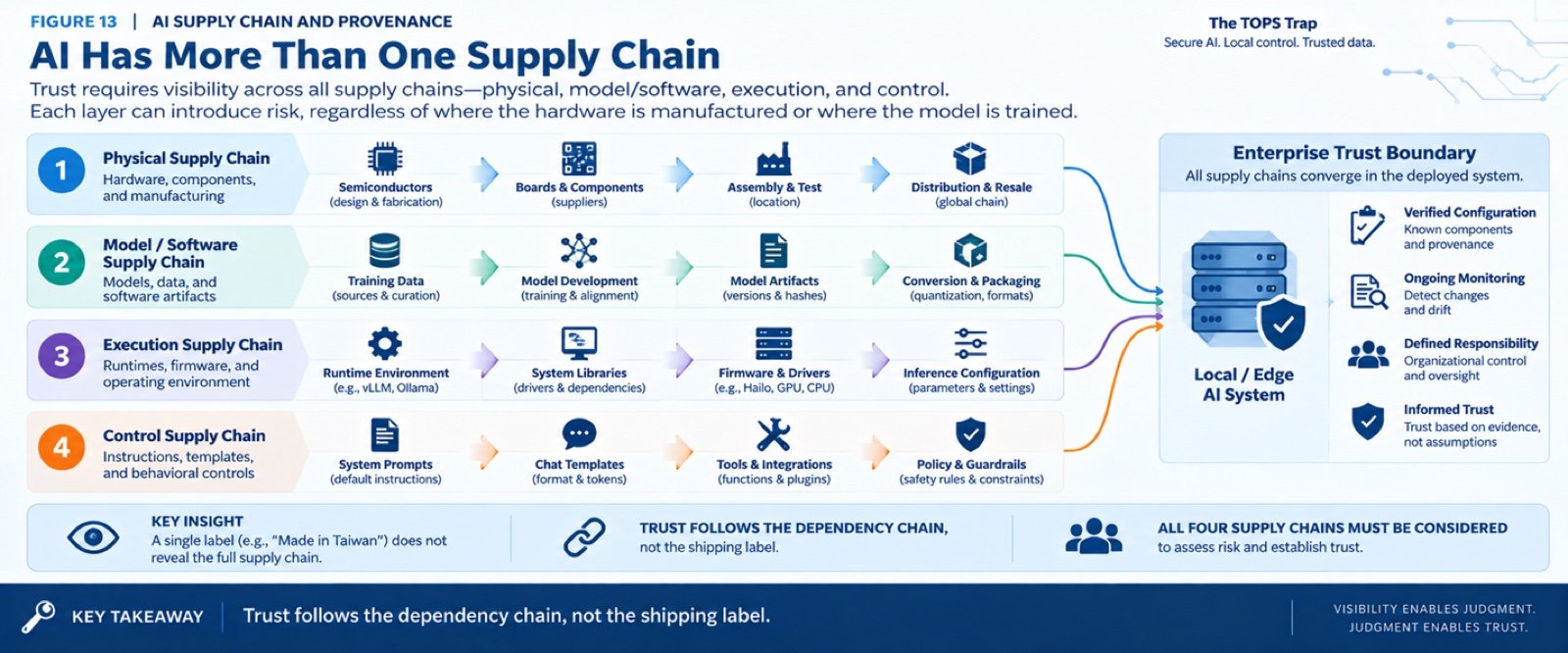
- Identify the exact artifact: model, revision, quantization, conversion path, tokenizer and chat template.
- Treat chat templates as versioned software, and make default system instructions visible to operators.
- Document the full model-conversion chain and keep a model bill of materials.
- Do not make the model responsible for enforcing its own evidence boundary.
- Verify citations independently; a citation is not proof of grounding.
- Test for false absence as well as hallucination.
- Separate observation from attribution when reporting results.
A proposed trust benchmark
The full paper proposes an Edge-AI Trust Benchmark: 16 trust domains in five families (evidence integrity, epistemic discipline, control and provenance, operational reliability, and system governance). It reports a trust profile beside a separate performance profile, and critical failures cannot be averaged away.
Proposed · Edge-AI Trust Benchmark
Sixteen domains, reported as a profile
Trust sits beside performance as a separate axis. Critical failures cannot be averaged away.
- 1Source grounding
- 2Evidence recognition
- 3Evidence conflict
- 4Citation integrity
- 5Uncertainty and epistemic discipline
- 6Instruction transparency and control provenance
- 7Behavioral symmetry
- 8Provenance and artifact integrity
- 9Supply-chain visibility
- 10Technical reliability
- 11Repeatability
- 12Reproducibility
- 13Independent replication
- 14Auditability
- 15Architectural containment
- 16Consequence-aware action control
Key takeaway Performance answers “Can it run?” Trust answers “Can it be trusted?”